
For most flat or low-slope commercial roofs in Florida, spray foam roofing and silicone roof coatings are both strong options — but they solve different problems. Spray foam replaces and rebuilds your roof system; silicone restores a roof that still has structural integrity. The right choice depends on your substrate condition, drainage, and long-term plans for the building.
- Spray foam roofing (SPF) is a full roof system — it replaces what’s there and adds insulation and slope.
- Silicone roof coating is a restoration — it seals and protects a roof that is still structurally sound.
- Substrate condition determines eligibility; a wet or deteriorated deck rules out silicone.
- Both systems need routine maintenance, and the warranty spells out the upkeep it expects.
- Neither system has a standard warranty covering hurricane or wind damage; on qualifying spray foam roofs, ask about adding a manufacturer’s Category 5 wind warranty.
What Each System Actually Does
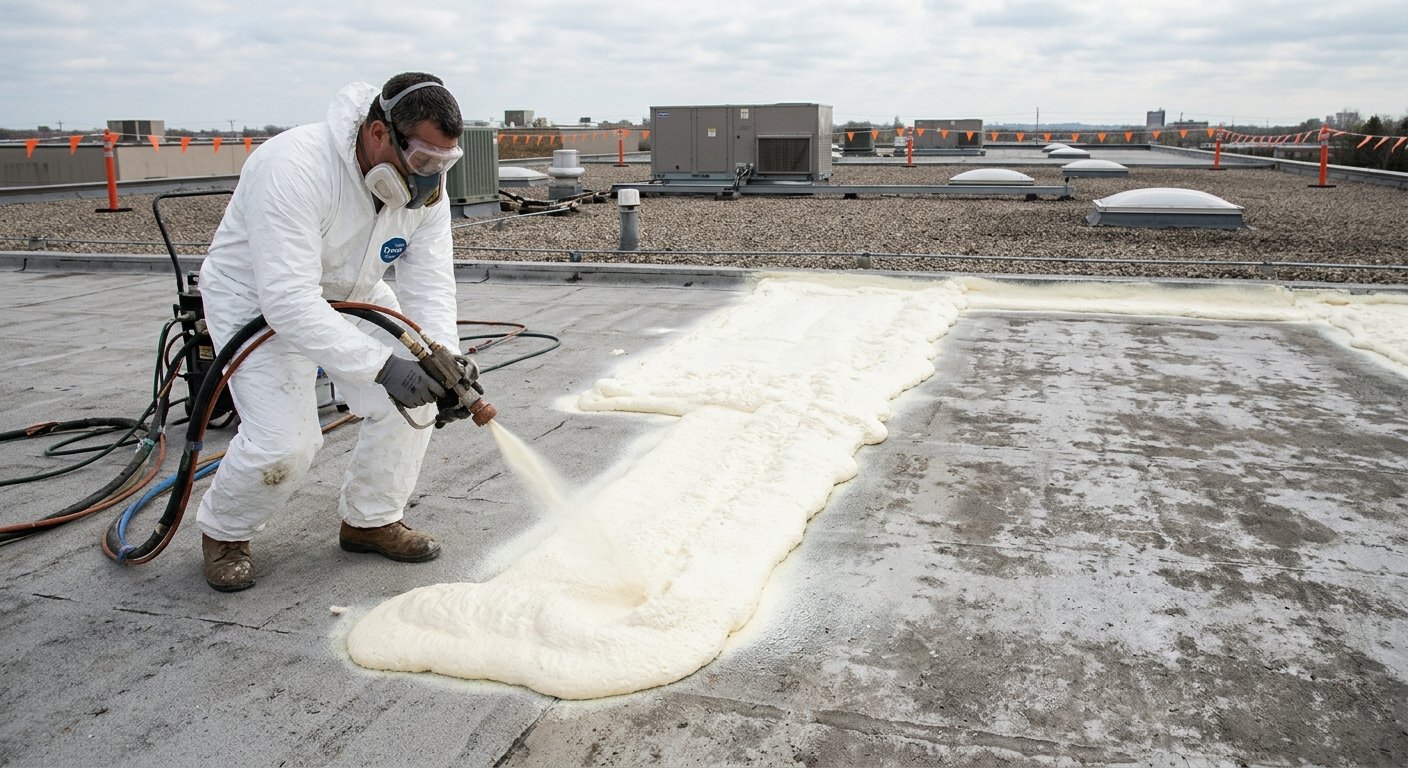
Understanding the distinction matters before you compare anything else. These are not competing versions of the same product — they are fundamentally different approaches to a commercial roof.
Spray foam roofing (SPF) is a closed-cell polyurethane foam applied directly to the existing deck. It expands on contact, fills voids and irregularities, adds thermal insulation, and creates a seamless, monolithic surface. A protective elastomeric topcoat — often silicone — is then applied over the foam to guard against UV degradation and moisture. The result is a complete commercial spray foam roof system that replaces the old roof assembly rather than patching it.
Silicone roof coating is applied directly over an existing roof membrane that has been cleaned, prepared, and confirmed to be dry and structurally sound. The silicone forms a seamless, waterproof skin over the existing surface. It does not add meaningful insulation value or change the slope of the roof. It is a restoration, not a replacement.
Polo International installs full roof systems only — SPF roofs and silicone roof restorations as complete assemblies. Neither system is a repair or a patch application.
Side-by-Side Comparison
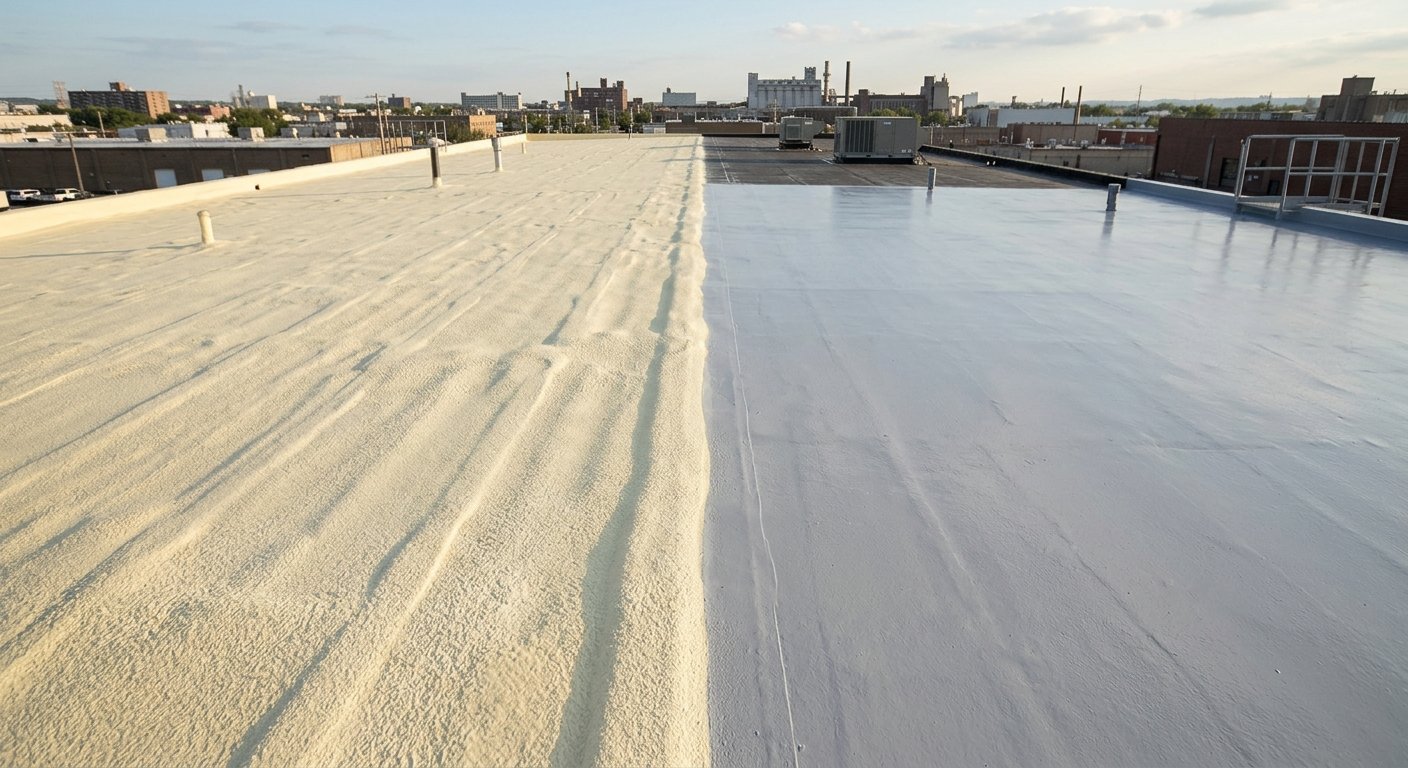
The table below covers the criteria that matter most to property managers and building owners evaluating these two systems.
| Criterion | Spray Foam Roofing (SPF) | Silicone Roof Coating |
|---|---|---|
| Substrate requirement | Deck must be structurally sound; wet insulation is removed before application | Existing membrane must be dry, adhered, and in good condition throughout |
| What it replaces | Entire roof system — insulation and membrane | Nothing removed; bonds over existing membrane |
| Insulation value | Yes — closed-cell foam is a high-R-value insulator | No meaningful insulation added |
| Slope correction | Yes — foam thickness can be varied to improve drainage | No — existing drainage must already be adequate |
| Seamless surface | Yes | Yes |
| Maintenance required | Annual inspection; recoat cycle per manufacturer specs | Annual inspection; recoat cycle per manufacturer specs |
| Typical application disruption | Moderate — crew on roof, equipment staging, wet insulation removed where found | Lower — applied over existing surface with less staging |
| Hurricane/wind warranty | Standard warranties don’t cover hurricane or wind damage; on qualifying spray foam roofs, a manufacturer’s Category 5 wind warranty can be added (terms in the written quote) | Standard warranties don’t cover hurricane or wind damage |
Substrate Condition: The First Gate
Before anything else, the condition of your existing roof determines which system — if either — can be applied without additional work.
For a silicone roof coating, the existing membrane must be fully adhered, free of blisters or delamination, and completely dry. Moisture trapped beneath the coating will cause it to fail. An infrared or nuclear moisture survey before any coating restoration confirms the membrane is dry throughout.
For SPF, the deck itself must be structurally sound, but the foam can bridge minor surface irregularities. Wet or deteriorated insulation is typically removed and replaced before foam is applied. This makes SPF the more flexible option when the existing assembly has sustained damage or saturation.
Applying any coating over a membrane that holds moisture — even in isolated areas — will cause blistering, adhesion failure, and shortened service life. A proper moisture survey is not optional; it is the foundation of an accurate scope of work.
Drainage and Slope
Florida’s rainfall intensity makes drainage a critical design factor for any flat roof. Standing water accelerates membrane degradation and increases leak risk over time.
SPF offers a practical advantage here: because foam thickness can be varied during application, contractors can build positive slope into a previously flat or negative-draining roof. This is one reason SPF is often the preferred choice for older warehouse and industrial roofs and retail roofs where the original slope was inadequate.
Silicone coating follows the existing surface exactly. If your roof drains poorly today, it will drain poorly after a silicone restoration. Any drainage correction would need to happen before the coating is applied — and at that point, you should evaluate whether SPF is the more efficient path.
Maintenance Obligations
Both systems need routine maintenance to keep them performing, and each warranty spells out the upkeep it expects. Neither is a “set it and forget it” solution.
For SPF roofs, maintenance typically includes annual inspections, prompt attention to any topcoat abrasion or penetration damage, and periodic recoating of the topcoat layer as specified by the manufacturer. The foam itself is durable; the topcoat is the sacrificial layer that takes UV exposure.
For silicone roof coatings, maintenance follows a similar pattern: annual inspections, cleaning to remove algae and debris that can degrade adhesion, and recoating at manufacturer-recommended intervals.
Recoating a worn topcoat is far less disruptive than replacing a failed membrane.
Polo International offers maintenance programs for both systems. Regular inspections catch minor issues — a small puncture, a compromised seam at a penetration — before they become scope-of-work items.
Decision Checklist: Which System Fits Your Building?
Work through these questions before your next conversation with a roofing contractor. They will help you frame the right scope and ask the right questions.
Get a moisture survey done
No coating or foam application should be scoped without knowing whether the existing assembly is dry. Commission an infrared or nuclear scan before any proposal is accepted.
Assess your drainage
Walk the roof after a rain. If water is ponding more than 48 hours after rainfall, your drainage is inadequate. Silicone cannot correct this; SPF potentially can.
Evaluate the existing membrane
Is it still fully adhered? Are there blisters, open seams, or sections that have been repeatedly patched? A compromised membrane is not a good substrate for silicone coating.
Consider your insulation needs
If your building is under-insulated and energy performance is a concern, SPF addresses both the roof membrane and insulation in a single installation. Silicone does not.
Clarify your wind exposure goals
On qualifying SPF roofs, a manufacturer’s Category 5 wind warranty can be added. If wind performance documentation matters for your building ask about this when you request a quote. It is not standard on every roof.
When SPF Is Usually the Right Call
- The existing membrane is saturated, delaminated, or heavily patched.
- The roof has inadequate slope and persistent drainage problems.
- The building needs improved thermal performance.
- You want the option to add a manufacturer’s Category 5 wind warranty on a qualifying installation.
- The roof is approaching the end of its service life and a full re-roof is the logical next step.
When Silicone Coating Is Usually the Right Call
- The existing membrane is in good condition, fully adhered, and confirmed dry.
- Drainage is adequate — water clears the roof within 48 hours of rainfall.
- The goal is extending service life on a roof that still has usable life remaining.
- Project timeline or occupancy constraints favor lower-disruption application.
- The building does not require insulation improvement.
Neither system should be selected before a thorough inspection and moisture survey. The substrate condition — not budget preference — should drive the recommendation. A silicone restoration applied over a wet membrane will fail well before its rated service life.
Frequently Asked Questions
Can silicone coating be applied over spray foam?
Yes. In fact, silicone is a common topcoat used over SPF roofing systems. When the topcoat on an SPF roof reaches the end of its service life, it can be recoated with silicone rather than replacing the foam layer beneath. This is one of the practical advantages of spray foam roofing — the substrate remains intact and the topcoat is the renewable component.
How do I know if my roof qualifies for silicone restoration?
Qualification depends on a full inspection and moisture survey. The existing membrane must be structurally sound, fully adhered, and free of trapped moisture. A contractor who skips the moisture verification step is not giving you an accurate scope. Polo International conducts inspections as part of its roofing services.
Does spray foam roofing qualify for hurricane wind warranties?
On qualifying SPF installations, a manufacturer’s Category 5 wind warranty can be added. Standard warranties for both SPF and silicone systems do not cover hurricane or wind damage. The specific terms, eligibility requirements, and what the wind warranty covers are outlined in Polo’s written quote — the details vary by project.
Is spray foam roofing approved under the Florida Building Code?
Yes. SPF roofing systems installed in Florida must comply with the Florida Building Code, which governs roofing materials, application, and product approvals. Contractors must use code-approved products and follow manufacturer installation requirements. Always confirm that your contractor pulls the required permits.
Get a written quote for your building
Contact Polo International to schedule a roof evaluation. We will assess your substrate, drainage, and project requirements, then provide a written scope and quote.