
Guides
Spray foam roofs and hurricane season
What Florida’s building code requires for a spray foam roof, what the teams who walked commercial roofs after Charley, Katrina, Ike and Ian found, and what to do before and after a storm.
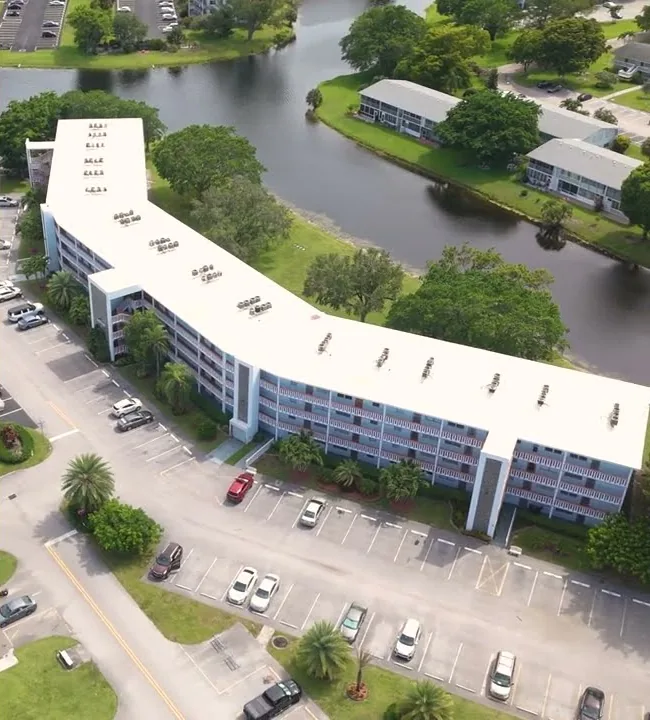
Westbury F, Century Village, Deerfield Beach: a 25,040 sq ft spray foam re-roof, June 2025
“The roof has been installed for 2 months. There have been many Tropical storms over this time and there have been NO LEAKS!”
Jeromre Spinner · Westbury F Condominium Association · Google review, July 2025 · See our reviews on Google
Your building
Is your building in the High-Velocity Hurricane Zone?
Florida’s building code defines the zone as Broward and Miami-Dade counties, and its roofing rules there are the state’s strictest. Pick your county to see which rules apply to your roof.
Broward County is in the High-Velocity Hurricane Zone. FBC 202
Product approval
Every part of the roof needs a current product approval. Where the maker’s instructions and the approval disagree, the approval wins.
FBC 1512.2.1Permits, even for a recoat
A repair or a recoat needs a permit: the code counts applying coatings as roof maintenance. Minor repairs the building official approves are the exception.
FBC 1512.3, 1513.1Inspected twice
The building inspector checks the roof while it goes on and again when it’s finished.
FBC 1512.4Tested for uplift
A flat roof system has to pass at least 90 pounds per square foot of tested uplift, and the code adds a 2-to-1 safety margin to the test.
FBC 1523.4, 1523.6.2Spray foam over an old roof
It needs a contractor certified by the foam’s maker, and the coating maker inspects it when it’s done. The certificate goes to the building official within 30 days.
FBC 1521.18Rooftop units
Units must be fastened to the structure for hurricane loads, and wood sleepers aren’t allowed.
FBC 1522.2
The code’s design wind speed for an ordinary building here is 170 mph (Risk Category II; your engineer confirms your building’s category). That’s what the building is designed for, not a rating for any roof. FBC 1620.2
Palm Beach County is outside the High-Velocity Hurricane Zone.
Designed for wind
Roofs are still designed for wind under the code’s structural chapter.
FBC 1504.1Product approval
Roofing products need a statewide or a local product approval.
Fla. Stat. 553.842, 553.8425Spray foam rules
A spray foam roof needs at least a 2% slope to drain, and a protective coating within 2 to 72 hours of spraying.
FBC 1507.14The zone’s rules, if adopted
The High-Velocity Hurricane Zone chapter applies outside Broward and Miami-Dade only where a city or county adopts it.
FBC 1512.2
Look up any roof product yourself: Florida’s product approval search or Miami-Dade’s NOA search. Re-roofing more than a quarter of the roof? Florida’s 25% roof rule applies everywhere.
The code
Florida’s code sets a spray foam roof’s slope, its coating window and its re-roof rules
The code has its own section for spray foam roofs, and extra rules for spray foam over an old roof in Broward and Miami-Dade.
| Rule | What it says | Section |
|---|---|---|
| Slope | At least a 2% slope to drain. | FBC 1507.14.1 |
| Coating | A protective coating within 2 to 72 hours of spraying: acrylic, silicone or moisture-cured polyurethane, each with its own ASTM standard. | FBC 1507.14.3 |
| Recoating | A worn spray foam roof can be recoated without tearing it off. In Broward and Miami-Dade the recoat needs a permit. | FBC 1511.3, 1512.3.1 |
| Over an old roof, in the zone | A product approval, a contractor certified by the foam’s maker, and the coating maker’s inspection when it’s done. If it can’t hold its design wind pressure, it comes off and gets replaced. | FBC 1521.18 |
| Drains | A re-roof can’t reduce the number or size of the drains or scuppers unless an engineer redesigns the drainage. | FBC 1514.4.2.2 |
Rated in pounds per square foot, not miles per hour
Miami-Dade’s own records list 34 spray foam roof system approvals, all for the High-Velocity Hurricane Zone (checked November 2026). They rate each roof in pounds per square foot of tested uplift, and the number changes with the deck under the foam. That’s why you won’t see a miles-per-hour rating for a spray foam roof on this page, and why Florida law bars selling a product as hurricane or windstorm protection unless it holds a product approval. Fla. Stat. 553.842(5)
After the storms
After Charley, Katrina, Ike and Ian, well-attached spray foam roofs mostly came through
After big hurricanes, federal and industry teams inspect commercial roofs and publish what held and what failed. Here’s what they wrote about spray foam roofs.
- 2004
Hurricane Charley
Most spray foam roofs the industry’s investigators saw would likely have kept performing if the edge had a proper foam stop, the old roof underneath had been fastened better and the equipment had been anchored. Flying debris gouged nearly all of them, and that damage was usually an easy repair.
RICOWI Charley/Ivan report, 2006 - 2005
Hurricane Katrina
Federal investigators found spray foam roofs near Pascagoula, some about 20 years old, came through with one minor exception, without blow-off or flashing damage. The one failure was under the foam: an insulation board with too few fasteners, less than 1% of that roof.
NIST Technical Note 1476 - 2008
Hurricane Ike
Investigators inspected five spray foam roofs. Four had no damage. On the fifth, metal fascia came loose where they found no cleats or fasteners holding it. They added a caution: many flat roofs in the areas they inspected also had little damage.
RICOWI Ike report, 2009 - 2022
Hurricane Ian
On one Port Charlotte condo, where foam had been sprayed over a metal roof, the foam stayed on. Investigators still rated its damage 3 on a scale where 0 is none and 6 is a roof cover torn off: widespread blistering, and the stone surface scoured at every edge, which had no metal edge.
RICOWI Ian report, 2023
Not a cure-all. After Charley, FEMA found that foam sprayed over a tile roof didn’t necessarily make that roof stronger against uplift. FEMA 488
Where roofs fail
The damage usually starts at the edge, not the middle of the roof
Across the reports, the same three places come up on flat commercial roofs. Roofs built after 2006 did better than older ones after Ian.
The edges
After Hurricane Michael, investigators wrote that edge failure is still the key starting point for flat-roof damage, and that almost all flat-roof failures begin at the windward edge.
RICOWI Michael report, 2019What we check: the edge metal and flashing.
Rooftop units
Loose units tumbling across the roof cause many of the punctures and tears in a storm.
RICOWI Michael report; FEMA 490What we check: every pipe, vent and equipment curb.
Gutters and copings
In the 2004 storms, lifting gutters, edge flashing and copings were the biggest problem on flat commercial roofs.
FEMA 490What we check: the drains and gutters.
Before and after
What to do before the season, and after a storm
Before the season
- Clear the drains and gutters.
- Tie down or remove anything loose on the roof.
- Check that fans, HVAC units and hoods are fastened to their curbs. Don’t count on their weight.
- Have the roof inspected twice a year, and again after a big storm.
From Ready.gov, FEMA and NRCA’s Professional Roofing.
After a storm
- Look at the roof from the ground only.
- Photograph the damage before anything is cleaned up, and dry the building out quickly.
- Have a roofer check every roof, even one that looks fine.
- Be wary of the lowest bid after a storm.
From NRCA, Ready.gov and FEMA.
Permits after a storm
In a real emergency, repairs can be made first and the permit application filed by the next working business day. After a declared emergency, local governments have to speed up permits for roof repairs and re-roofs, and they may waive the fees. FBC 105.2.1 Fla. Stat. 553.7922
What type of roof is best for hurricanes?
Florida’s code doesn’t rank roof types. For a flat commercial roof, what matters is a system with a current product approval for your building, attached right and finished right at the edges, where the storm reports find most failures start. In those reports, well-attached spray foam roofs mostly came through. The spray foam systems we install are hurricane-resistant, and your quote names the exact approved system.
How much wind can a spray foam roof withstand?
There’s no single number. Product approvals rate a roof in pounds per square foot of tested uplift, not miles per hour, and the rating changes with the deck under the foam. In Broward and Miami-Dade, a flat roof system has to pass at least 90 psf, with a 2-to-1 safety margin. You can look up the approval for your roof’s system.
Do spray foam roofs come with a hurricane warranty?
Your written proposal spells out the warranties on your roof: on our spray foam roofs, a 20-year manufacturer labor and material warranty plus our own 20-year warranty. Hurricane and wind damage isn’t covered by the warranties, so for storm damage, look to your property insurance.
Do I need a permit to fix my roof after a storm?
Usually, yes. In Broward and Miami-Dade even repairs and recoats need one, except minor repairs the building official approves. In a real emergency, repairs can start first and the permit application follows by the next working business day. After a declared emergency, local governments must speed up roof permits.
Can a spray foam roof be recoated instead of replaced?
Yes. Florida’s code lets a worn spray foam roof be recoated without a tear-off. In Broward and Miami-Dade the recoat needs a permit, because the code counts applying coatings as roof maintenance.
Is my building in the High-Velocity Hurricane Zone?
If it’s in Broward or Miami-Dade County, yes: Florida’s building code defines the zone as those two counties. Palm Beach County and the rest of Florida are outside it, though roofs there are still designed for wind. See the rules for your county.
Where we come in
Before the season or after a storm, we look at the roof and put it in writing
We inspect the roof
The edge metal and flashing, the units and their curbs, the drains and gutters, and the foam and coating itself.
You get it in writing
What the roof needs and a written quote with the system and the price, before anything starts.
We pull the permits
We apply for them once the contract is signed and see the job through to the final inspection.
Certified installer for